The dance of death with characters |

|
||||||
|
Austria
Croatia
Denmark
Estonia
Finland
France
Germany
Great Britain
Italia
Poland
Slovenia
Sweden
Switzerland
Manuscripts
Copyright (textes) |
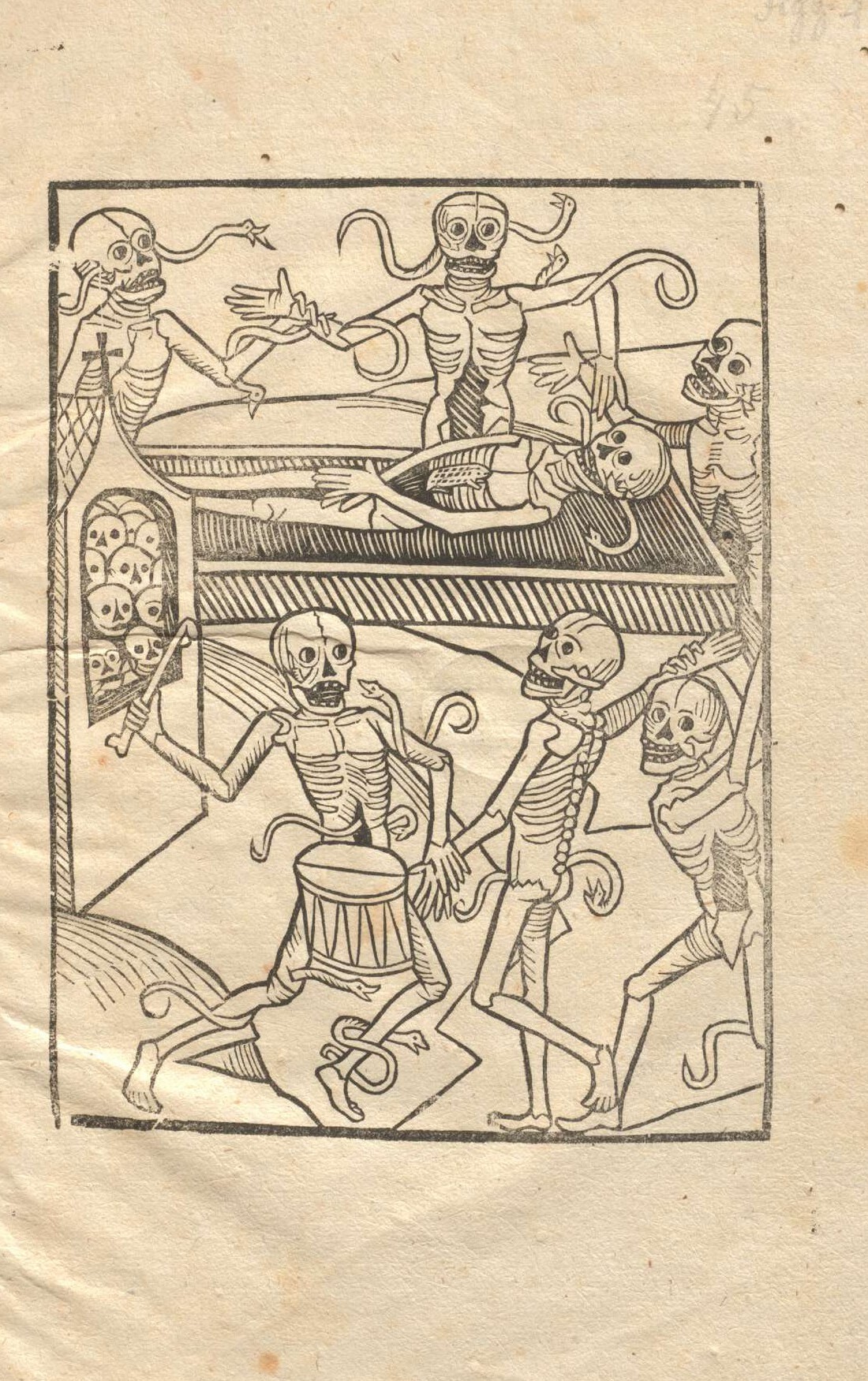
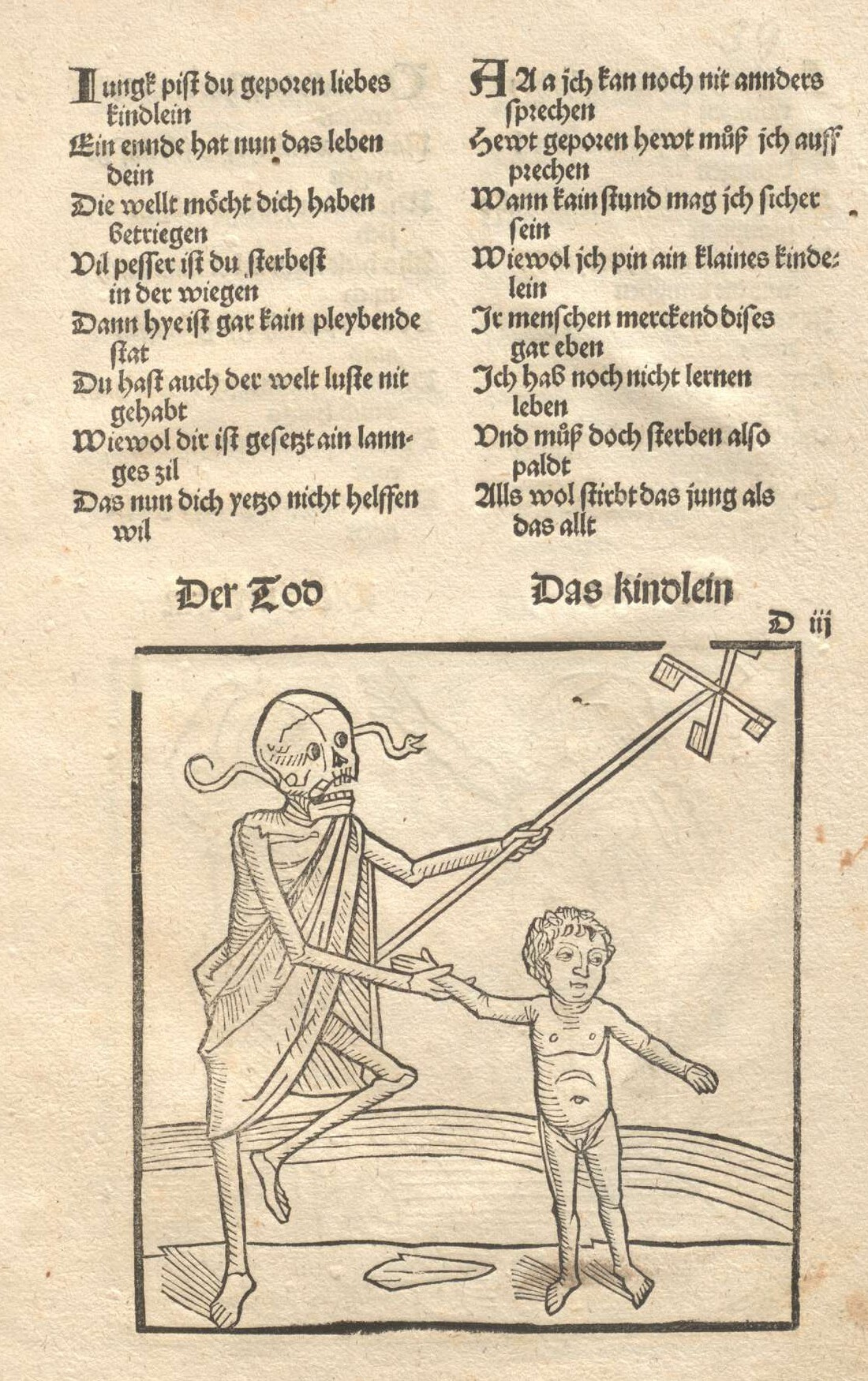
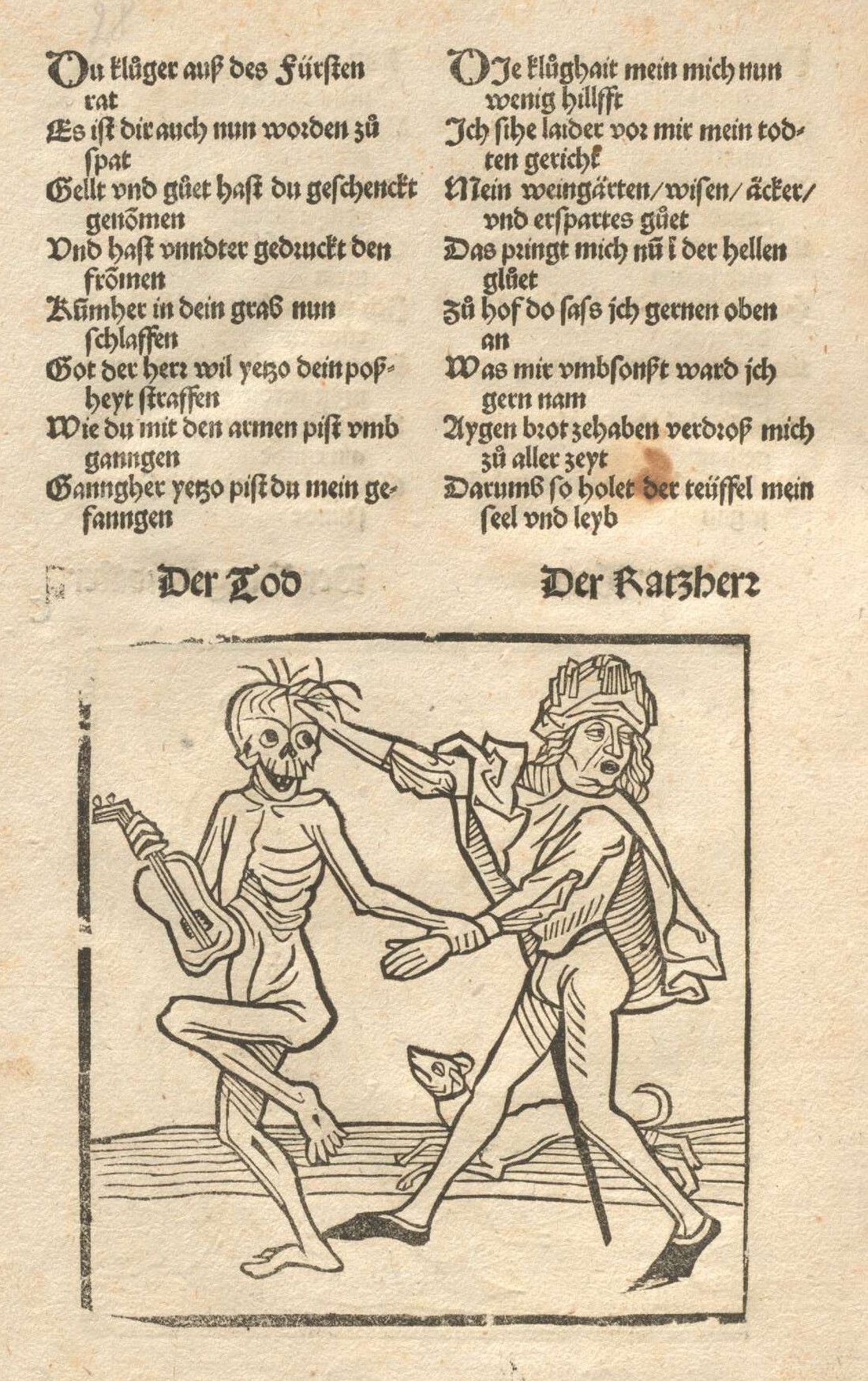
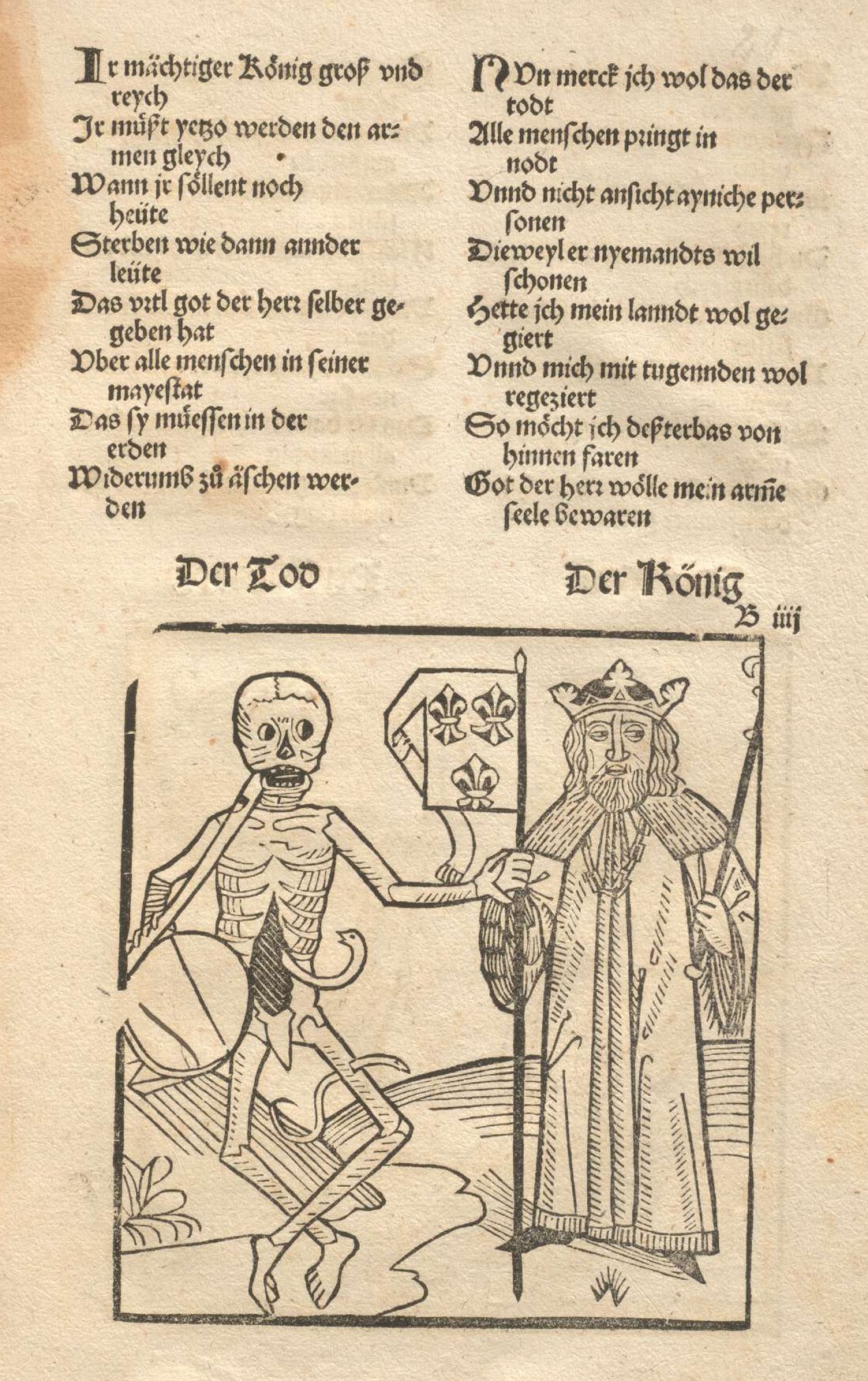
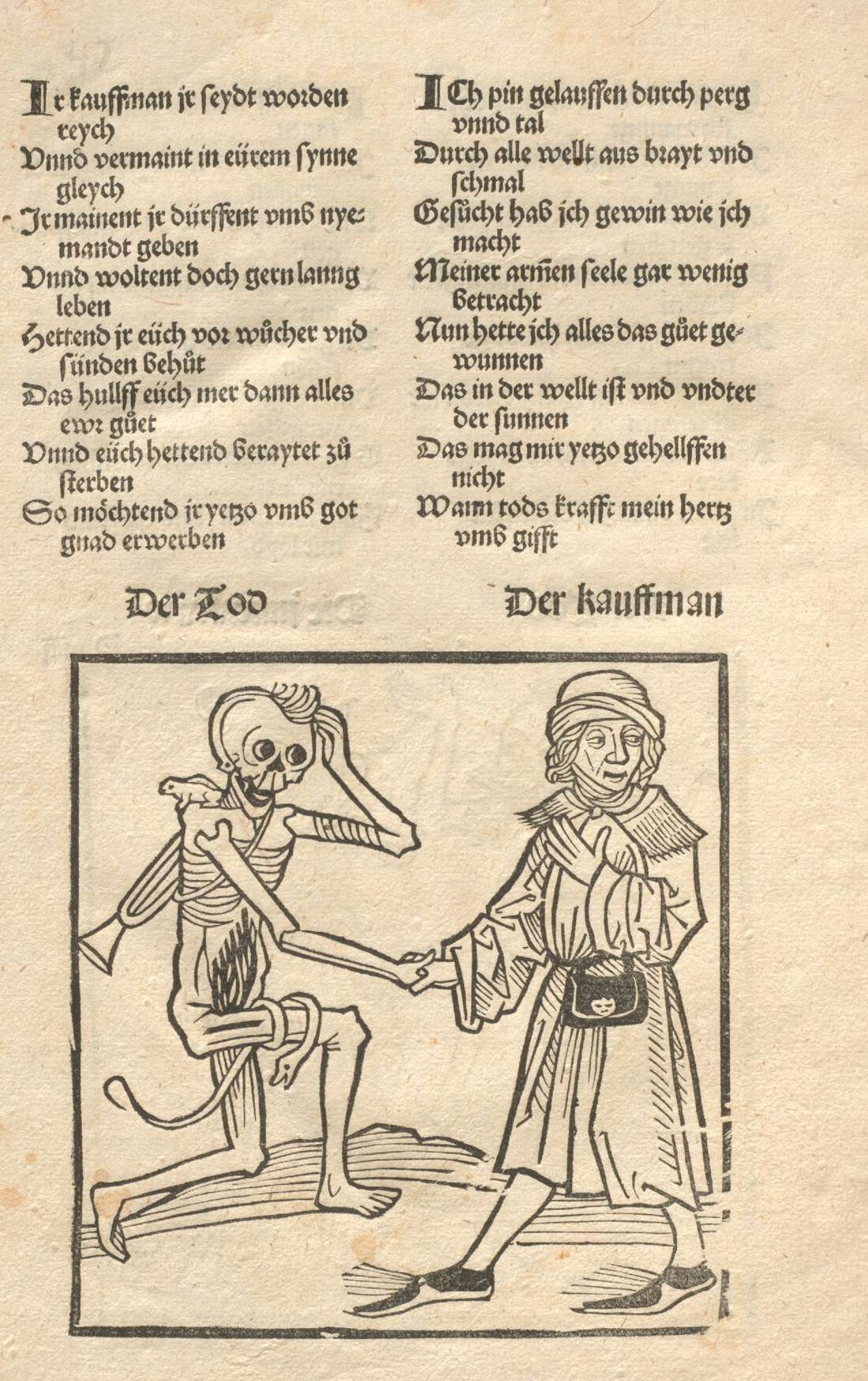
This dance of death, called the Der Doten dantz mit figuren. Clage und Antwort schon von allen staten der welt, begins with four cadavers playing music and three others dancing in front of a house. The next picture shows six putrefying bodies dancing around a dead man, lying in his coffin next to an ossuary. The actual dance of death is made of 38 woodcuts. In the last picture, five bodies get out of their graves; this conclusion, as well as the introduction, recall some medieval supersitions. The artist who engraved the woodcuts is unknown. The printer was probably Heinrich Knoblochter, who left Strasbourg in 1486 and settled down in Heidelberg. He would have printed this dance of death two years later. A reprint was made in 1492 by Jacob Meydenbach in Mainz and by Hans Schobser around 1520. Only seven copies of the first edition (two of them incomplete), five of the second and two of the third are known worldwide. We still do not know exactly where this dance of death was created. The verses are written in a dialect from the Rhineland; but one of the pictures shows the count bearing the coat of arms of a family from Württemberg, that lived at this time in Alsace, and not the emblem of the Rhineland-Palatinate area. Furthermore, the Doten dantz has much in common with the dance of death painted in the Innocent's cemetery in Paris , as regards the pictures as well as the verses. This influence probably came from the book on Paris' dance of death that Guyot Marchand printed in 1485. In both works of art, Death and his victims talk in eight-line stanzas. There are similarities between both versions of the doctor's speech, of the abbot's speech, and of the epilogue. In the Doden dantz the king holds a banner and a sceptre decorated with fleurs-de-lys ; Death calls the doctor a " great master from Paris ". However, the artist did not imitate slavishly his model. For example, he included women: a nun, a burgher wife and a maid in his dance of death, what the painter of the Innocents' cemetery did not do. Furthermore, the Doden dantz presents peculiarities we find in only few dances of death. Clerics and laymen are separated, which is rare in the works from the 15th century. In one picture Death does not dance with a single partner, but with a group of characters from various social classes. It is also worth noticing that 35 out of the 38 skeletons hold music instruments. Only the herald, the burgher and the child defy this rule. The appearance of Death is also different. Instead of being a mere skeleton, he has a fleshless and disemboweled body which is seldom dressed with a shroud ; in many pictures snakes and toads jump out of his body. This dance of death never was a frescoe ; it had been purposely conceived to stand in a book. The artist had to adapt the artistic genre to its new medium. The traditional form of the dance of death, the so-called " farandole ", could not be maintained. It became a pas de deux executed by Death and one victim at a time ; Death gesticulates, hops about, drags the living along or plays music. According to a theory that has not been verified yet, this dance of death could have been created in two steps : the first one in Strasbourg, where the images and the titles would have been made, and the second one in Heidelberg, or at least in the Palatinate area, where the text would have been added to the pictures. This hypothesis could explain the discrepancy I expounded above between the Rhinelandish dialect of the verses and the picture with the Württemburgish coat-of-arms. It could also explain other peculiarities. When Death talks to the innkeeper, he specifies that the man comes from the village of Bingen (on the Rhine); the picture of the virtuous monk, who wears a rope around his waist, shows clearly that he belongs to the Franciscans ; the bad monk is also a dominican friar, even though the text does not tell us. In the same way, the senator speaks verses that would suit a royal adviser better than a city councillor. Finally, in the original edition clerics and laymen were separated in a strange way : the characters 1 to 9, 26 to 29, and 34 belonged to the clergy, whereas the numbers 10 to 25, 30 to 33, and 35 to 38 were laymen. This " mistake " was corrected in the second edition of the dance of death, that was published 1492 in Mainz; the new editor numbered the clerics 1 to 16, and the laymen 17 to 39.
The library of the University of Heidelberg has digitized the first edition of this manuscript (Knoblochtzer) which pictures show some elements colored in red. Another copy of 1488, this one skillfully colored is kept at the Bayerische Staatsbibliothek (State Library of Bavaria) in Munich. This german institution also possesses the second edition of Meydenbach (1492), colored with less skill than the previous manuscript, and the third edition of Hans Schobser (1520) in black and white.
|
||||||